
When Caregiving Creates Conflict — How Couples Can Reconnect and Support Each Other
- Lee Serene
- Apr 30
- 6 min read


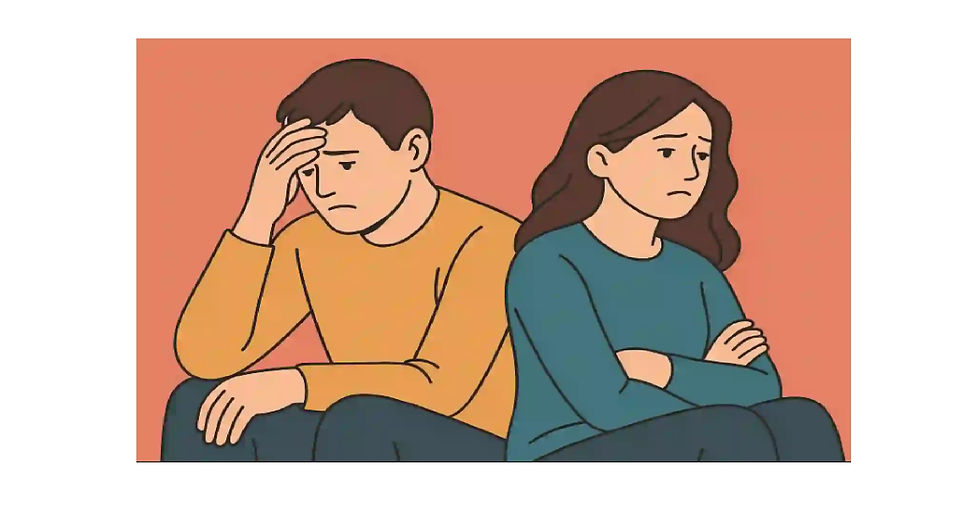
When caregiving enters a relationship, many couples are not prepared for how deeply it can affect their communication, emotional connection, and daily interactions.
Arguments may repeat.
Conversations may feel tense.
Both partners may feel misunderstood.
Yet beneath the conflict, there is often a shared reality: Both are trying... just in different ways.
Reconnection does not come from solving the external problem immediately. It begins with changing how the couple interacts with each other.
1. Shift from Content to Emotion: Finding the "Heart" of the Matter
Reconnection often starts not with addressing the external issue, but with transforming how we present ourselves to each other. During heated disputes about medical expenses or caregiving arrangements, it is easy to get trapped in the "Surface Content"... the practical aspects of the conflict.
a) The Concept: Uncovering Primary Emotions
In many caregiving-related conflicts, one partner is seeking emotional support, while the other is trying to solve or avoid the problem. This mismatch creates frustration.
In Emotionally Focused Therapy (EFT), we understand that feelings of anger or frustration are often a "secondary emotion"... a protective shield. Underneath this protective layer usually lies a Primary Emotion that is more difficult to express, such as fear, loneliness, or a sense of inadequacy. When we only respond to the anger, we miss the heart of what our partner is actually experiencing.
b) The Shift: From Accusation to Vulnerability
One of the most common escalation triggers is when the discussion shifts from the situation to personal judgment.
The goal is to replace reactive patterns (which push partners away) with emotional expression (which draws them in).
-Instead of a "You" Statement: "You never assist with the appointments; it is like you don’t even care."
-Consider using an "I" Statement: "I am feeling a deep sense of loneliness in managing this responsibility. To be honest, I am afraid that I can’t handle this burden by myself, and I really need to feel you are with me."
By shifting the focus from the "problem" to your internal world, you move away from assigning blame and move towards mutual understanding. Phrases like "I feel overwhelmed handling this alone" or "I feel a sense of loss when this stress creates distance between us" enable your partner to recognize your suffering instead of your protest. This openness serves as the bridge that reconnects you.
When emotions are acknowledged, defensiveness often softens.
2. Separate the Person from the Problem
When the heavy demands of responsibilities of caregiving come into a household, they often act like an unwelcome "third party" in the relationship... a silent guest that drains time, energy, and closeness.
a) The Concept: Shifting the Burden Away
In Narrative Therapy, we employ a method known as Externalization. The goal is to change your perspective, so you no longer perceive your partner as the barrier or the cause of your irritation. As such, you begin to see the "Caregiving Burden" as an external influence impacting the relationship from the outside. When the problem is viewed as being "out there," it no longer has to live "between" the two of you.
b) The Shift: Adopting an "Us vs. The Challenge" Perspective
By moving toward a Systemic Approach, you stop viewing the situation as a personal conflict and start seeing it as a shared mission. This shift reduces the body’s natural "fight-or-flight" response; when your partner is no longer the "enemy," you do not need to stay in a defensive posture.
The Old Narrative: "You are making this so much harder for me."
The New Narrative: "This situation is really tough for both of us. It is not you against me; it is about us facing this challenge together. How can we share this burden today?"
Couples can reframe by focusing on:
the shared challenge, not individual blame
the impact of the situation, not the character of the people involved
Identifying the stressor as an external factor helps you restore your partnership. It serves as a reminder that although you may not always have control over the caregiving conditions, you can control the way you confront them as a united team.
This helps both partners feel less attacked and more willing to engage.
3. Set Emotional Boundaries
In stressful environments, the manner in which a conversation starts often influences how it ends. When we feel exhausted from caregiving, it is common to slip into "Harsh Startups"... beginning a discussion with criticism or frustration - which almost always results in defensiveness.
a) The Concept: The Gottman Method’s "Softened Startup."
Based on the Gottman Method, we encourage the use of a Softened Startup or Gentle Beginning. This means approaching a difficult topic with gentleness and focusing on your own needs rather than highlighting your partner's faults. By lowering the intensity of the "opening," you allow the relationship to have room to grow.
b) The Shift: Establish "Safe Zones."
Given that caregiving can often feel overwhelming, it is essential to create "Safe Zones," designated physical or time-specific areas where the responsibilities of caregiving are completely set aside. Whether it is the dining table, the bedroom, or a particular hour in the evening, these havens help maintain your relationship as a partnership instead of merely a space for managing tasks.
Caregiving topics can become emotionally overwhelming if discussed repeatedly without structure.
Couples can benefit from setting emotional boundaries around conversations.
To reduce emotional overload, work together to reach a gentle agreement on:
• The "When" to communicate: Finding a time to talk when both partners have the capacity to listen
• The "How Much" information to share: Recognizing that not every detail needs to be processed at every moment
• The "Tone" to use: Committing to a baseline of respect, even when the subject matter is painful
By setting these boundaries, you are not avoiding the problem; you are preserving the energy you need to face it. This approach is supported by self-regulation theory, which emphasises the importance of managing emotional intensity. You are making a conscious choice to protect the relationship from being swallowed by the crisis.
4. Practice Dual Empathy
In the world of caregiving, it is common for one partner to feel like the "primary" sufferer, which can unintentionally lead to a Nurturance Gap.
When one person’s external load is clearly heavier, we often fall into the trap of thinking only their stress is valid. However, for a relationship to survive, we must practice Relational Reciprocity.
a) The Concept: The Reality of Two Perspectives
The emotional experience of the "supporting" partner is just as real as that of the "primary" caregiver. Stress should not be viewed as a competition. By acknowledging that both partners are carrying a heavy burden... just in different ways, you can avoid the accumulation of resentment and feelings of isolation.
b) The Shift: Practicing Presence Validation
One of the strongest tools a couple can use is Validation. It is important to understand that when you validate your partner, it does not mean you have to agree with their reasoning or their perspective on the facts; it just means you acknowledge their internal experience as genuine and deserving of respect.
For the Caregiver: It is essential for them to have their partner recognize the immense emotional and physical burden they carry.
For the Supporting Partner: They require an understanding of their individual stressors and the boundaries they need to maintain to keep the household running.
Validation does not mean agreement. It is important for both partners to feel acknowledged. Empathy does not mean agreement; it means recognising the emotional experience behind the words.
When you say, "I can understand how challenging this is for you," you are not settling an argument. You are telling your partner, "I acknowledge your feelings, and you are not facing this alone."
The partner who provides care requires an understanding of their emotional burden, while the other partner requires empathy for their stress and boundaries.
This mutual acknowledgment is what changes two individuals who are struggling alone into a couple who can endure together.
From an emotion-focused therapy (EFT) perspective, emotional validation is the foundation of reconnection.
Closing Reflection
Caregiving is not only a practical responsibility.
It is an emotional experience that can either distance or deepen a relationship.
Couples do not need to agree on everything.
But they need to feel that they are on the same side. The real challenge in a relationship is not the absence of pressure; it is how you handle the "squeeze."
When the unending responsibilities of caregiving weigh us down, our perspective often becomes limited. We stop seeing our partner as our teammate and begin seeing them as another "problem" to be managed or an obstacle to overcome.
It is important to keep in mind that the conflict is often not about the parents. More often, it is the sound of unfulfilled emotional needs within the relationship that are crying out for attention. It is about wanting to be acknowledged when you are exhausted, to receive support during tough times, and to feel secure when life seems unpredictable.
Understanding these psychological dynamics allows a couple to transition through three powerful shifts:
• From Blame to Awareness: Moving from "What are you doing wrong?" to "What is happening to us?"
• From Reaction to Reflection: Replacing the heat of the moment with the stillness of understanding.
• From Distance to Connection: Turning toward each other instead of away.
Because in the end, despite the different roles you may play in the caregiving journey, the heart desires the same things: to feel respected, to feel valued, and...most importantly, to understand that we are not alone.
What do you think matters more in difficult conversations - being understood, or finding a solution?


Comments